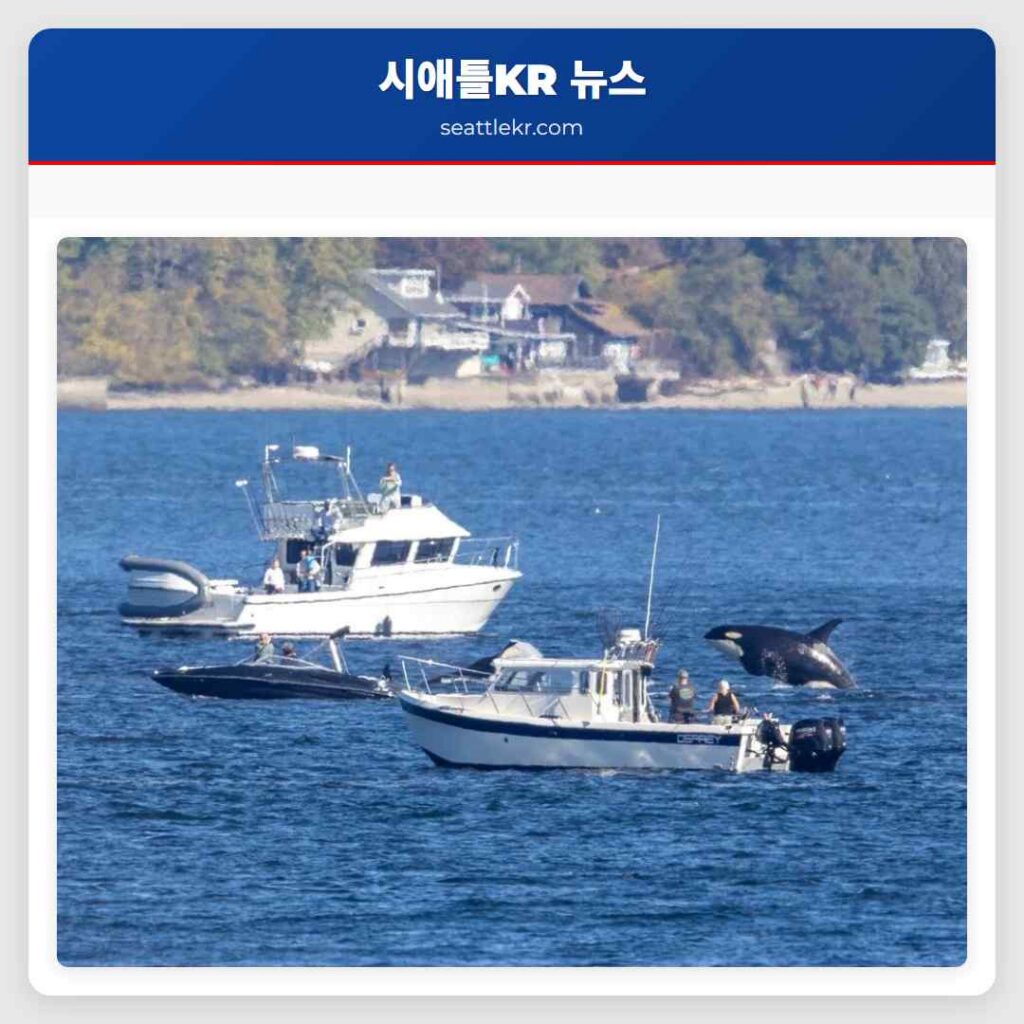
OLYMPIA, Wash. – With Memorial Day weekend approaching and Seattle preparing to host FIFA World Cup matches this summer, the Washington Department of Fish and Wildlife (WDFW) is reminding boaters to keep their distance from endangered Southern Resident killer whales.
State law requires all boaters – including those using motorboats, sailboats, and paddlecraft – to stay at least 1,000 yards away from Southern Resident killer whales, a regulation that took effect in 2025.
Summer marks the busiest boating season in Puget Sound and the Salish Sea, while also serving as a critical feeding period for the endangered orcas as salmon return to regional rivers, the agency said.
The whales rely on echolocation to hunt, and vessel noise can interfere with their ability to find food, according to WDFW.
A photo of the southern resident J-Pod whales in the south Sound in September 2025. (Photo: Noelle Morris via #SoNorthwest Photography){ }
“Boaters in Washington play a key role in saving our endangered orcas,” Julie Watson, WDFW’s killer whale policy lead, said in a statement. “Staying 1,000 yards away quiets the waters so orcas get enough to eat, which can mean life or death for pregnant mothers and baby orcas.”
Many local boaters are already familiar with the law, but visitors arriving for World Cup matches in Seattle and Vancouver this June and July may not know the regulations, the agency said.
“Boaters who are already doing their part by staying 1,000 yards away from Southern Resident orcas can help set an example for new or visiting boaters,” Watson said. “As we welcome the World Cup to the region this summer, help us keep orcas in the game by giving them space.”
Boaters who find themselves within 1,000 yards of Southern Resident killer whales should slowly move away at speeds of 7 knots or less, WDFW said.
If whales come within 400 yards of a vessel, operators must move out of the whales’ path and, when safe, disengage the vessel’s transmission until the whales are at least 400 yards away.
A photo of a new calf spotted on Feb. 16, 2026, in the Strait of Juan de Fuca. (Courtesy: Center for Whale Research){ }{ }
The agency also highlighted new Canadian vessel management measures announced in April that require boaters to stay 1,000 meters away from Southern Resident killer whales.
The Canadian rules take effect June 1, 2026, aligning protections across the U.S.-Canada border.
Boaters on both sides of the border must also remain at least 200 yards or meters away from transient, or Bigg’s, killer whales commonly seen in the Salish Sea and along the outer coast.
Because Southern Resident and Bigg’s killer whales can be difficult to distinguish, WDFW recommends treating any unidentified killer whale as a Southern Resident and maintaining a 1,000-yard distance.The agency encouraged boaters to watch for the Whale Warning Flag, an optional notification tool from the San Juan County Marine Resources Committee that signals whales may be nearby. Boaters are also encouraged to use the Whale Alert app to plan routes that avoid Southern Residents.
트위터 공유: WDFW urges boats to give endangered orcas 1000 yards cutting noise during peak feeding